

Let’s face it: today’s Artificial Intelligence sometimes understands customer behavior better than human advertisers do. AI is being utilized across various business dimensions, and digital advertising is no exception. Google recently rolled out an AI-driven feature for its search campaigns, and after extensively testing it across multiple projects at Digital Break Time, I want to share a real-world review of the Google Ads Search AI Max feature. Does it actually work? Let’s dive into the results.
A Real Review of Google Ads Search AI Max: How to Reduce CPC and Boost Quality Score with AI
- What exactly is Google Ads Search AI Max?
- 1. Quality Score Skyrockets While CPC Drops Significantly
- 2. Massive CTR Growth and Lower CPA
- 3. Controlling the AI Max System with Negative Keywords and URL Exclusions
- 4. The Hybrid Approach: Running Standard Search and AI Max Together
- 5. The Crucial Learning Phase: Give It at Least One Week
- 6. High-Quality SEO and AEO Content Supercharges AI Max
What exactly is Google Ads Search AI Max?
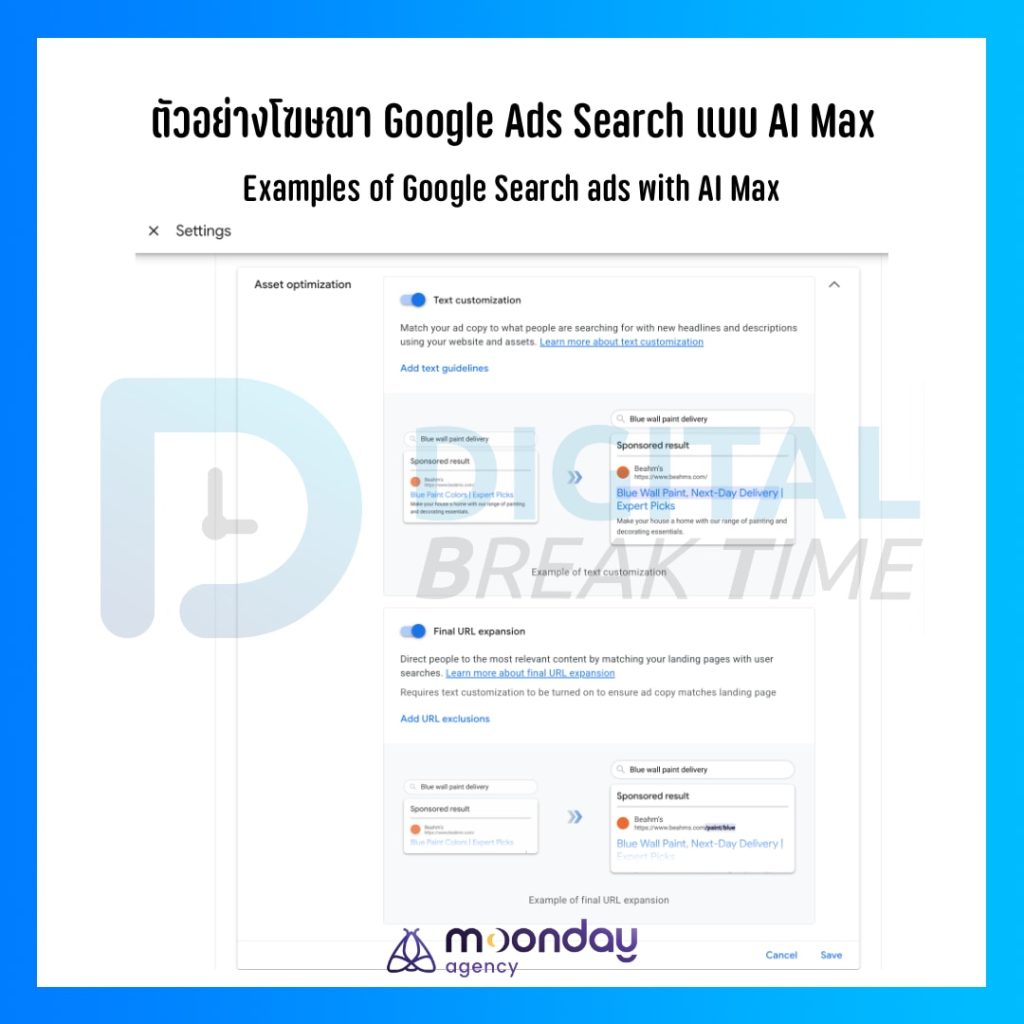
Google Ads has been steadily shifting towards automated tools. The latest evolution in Search campaigns is the AI Max format. Simply put, this allows Google’s AI system to automatically generate ad elements for you. It creates new Headlines and Descriptions on the fly and independently scans your website to find the most relevant Landing Page (Final URL) that perfectly matches the searcher’s intent.
Here is how it works: the system pulls the Title and Description directly from your specific landing pages to generate real-time ad copy. For example, if a user is searching for educational information, the AI might pull one of your relevant blog posts and use its specific Title and Description for the ad. Because this precisely matches the user’s current research intent, your ad performance significantly improves.
Setting this up is incredibly simple. You create a standard Search campaign, input your keywords, and write your base ad copy (this base copy is necessary for the AI to use during its initial Learning Phase). Then, you simply check a box in the campaign settings to enable the AI to start pulling and testing other relevant landing pages from your site. That’s it—you are now using AI Max.
So, how does it perform compared to standard campaigns? At Digital Break Time, we’ve summarized our hands-on experience using Google Ads Search AI Max so you know exactly what to expect before you try it yourself.
1. Quality Score Skyrockets While CPC Drops Significantly
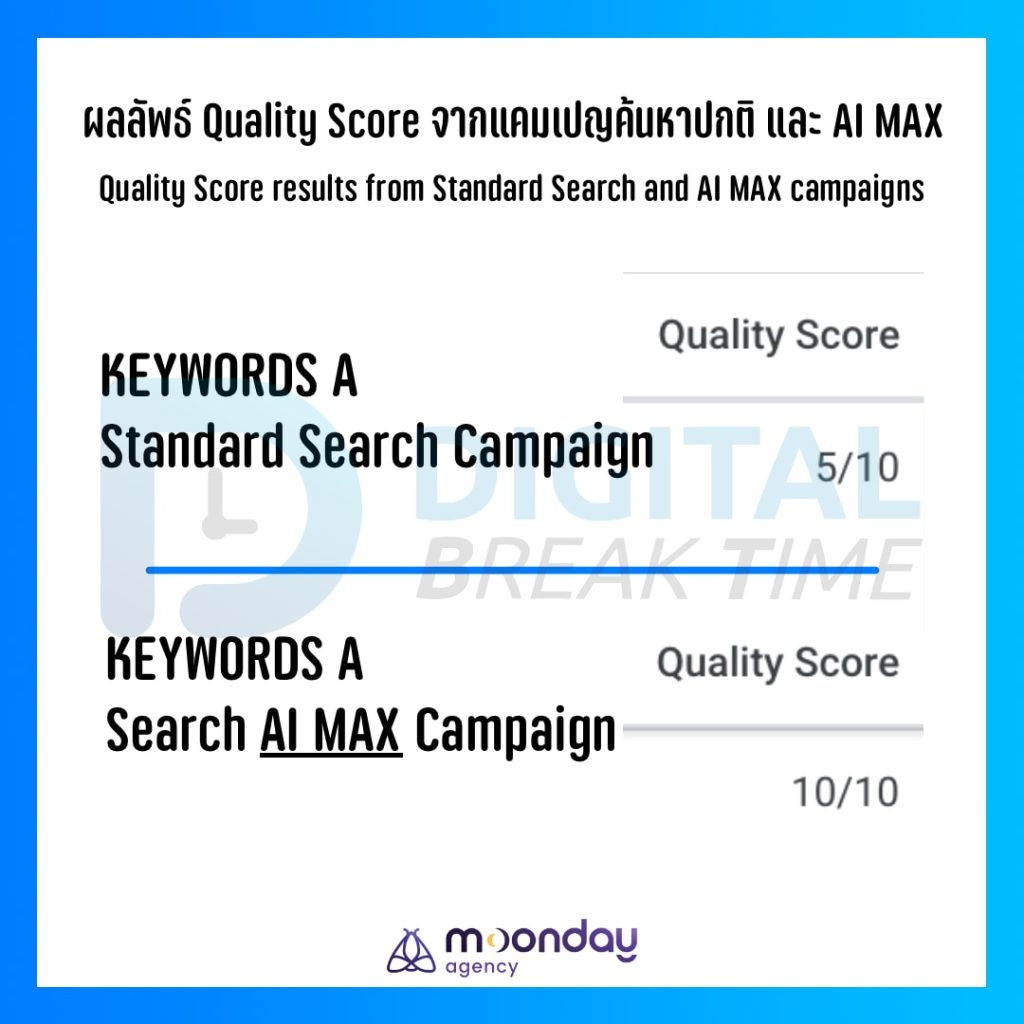
In Google Ads, your Quality Score relies on three main factors:
- Ad Relevance: How closely your ad copy matches the keywords.
- Expected CTR (Click-Through Rate): The likelihood that your ad will be clicked, indicating it aligns well with user intent.
- Landing Page Experience: How users behave on your site (e.g., fast loading times, time spent reading, clicking through to other pages).
When all these factors improve, your overall Quality Score goes up. The AI Max system elevates all three simultaneously.
When human advertisers write ad copy (Ad Relevance), we naturally tend to push promotions, sales, or lead-generation messages. AI Max does the opposite. It selects titles and descriptions directly from your landing pages that best match the search query. If it selects a highly informative, keyword-rich article to show the user, the Landing Page Experience naturally improves. Users stay longer and read more pages. Everything works in perfect harmony, leading to a significant increase in Quality Score.
In our tests, a keyword that scored a 5/10 in a standard campaign jumped to a perfect 10/10 in the AI Max campaign.
Even better, the overall Cost Per Click (CPC) dropped by about 40%. (Note: This is a comparison between two campaigns in the same industry; your results may vary). Essentially, we were spending the exact same amount of money but receiving significantly more clicks. In our specific case study, the CPC dropped from 18.28 THB in the standard campaign down to just 9.87 THB in the AI Max campaign.
2. Massive CTR Growth and Lower CPA
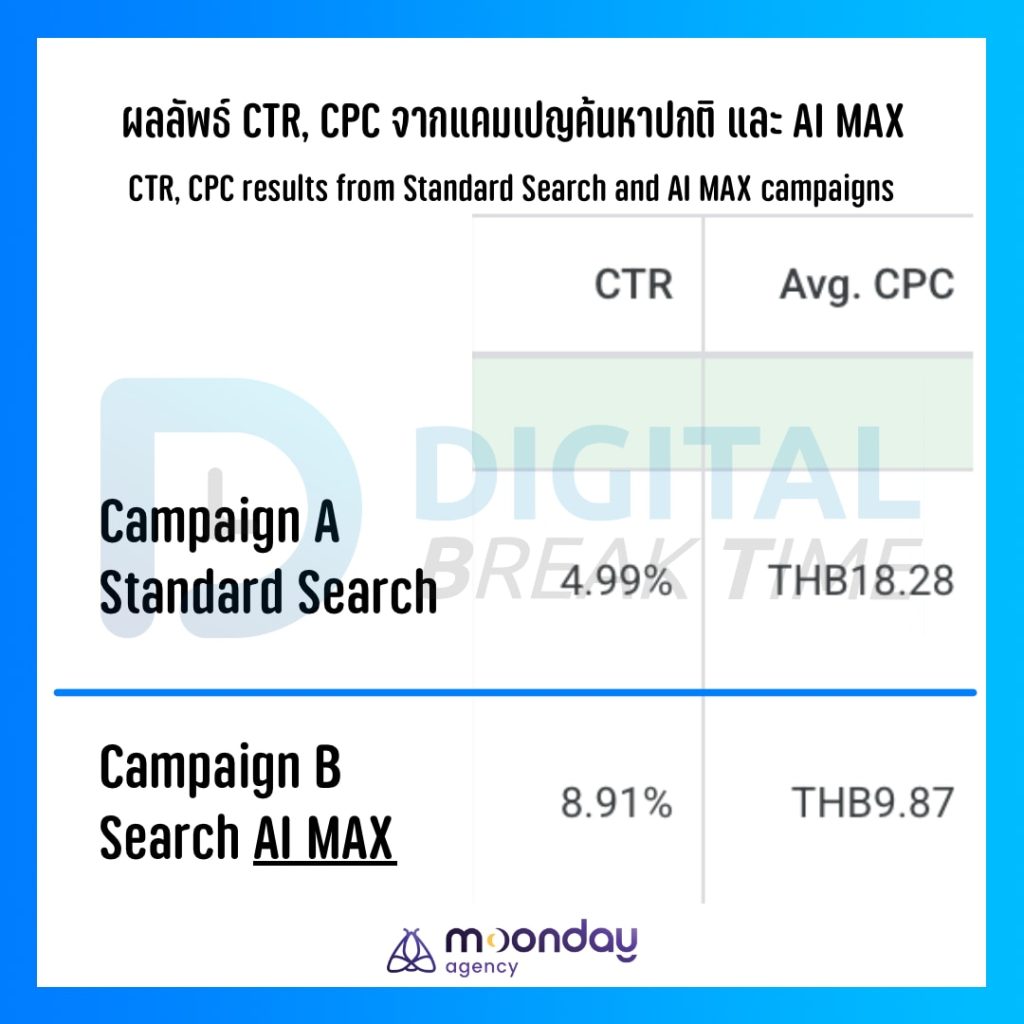
Because the AI perfectly matches user intent with the right keywords and ad copy, the Click-Through Rate (CTR) naturally increases. In our testing, the standard campaign had a CTR of 4.99%. However, when using the Google Ads Search AI Max format, the CTR leaped to an impressive 8.91%.
Furthermore, the CPA (Cost Per Acquisition/Action) dropped significantly—roughly by 20% to 40%, depending on the specific business niche. This means we instantly generated more conversions without having to increase the advertising budget.
The only metric that remained relatively unchanged was the Conversion Rate. Our hypothesis is that because AI Max frequently selects educational blogs or articles as the Final URL, the people clicking are often in the research phase and might not be ready to buy just yet. Additionally, informational blog pages usually lack aggressive “Call to Action” buttons compared to sales pages. Therefore, the overall Conversion Rate remained on par with the standard campaign, even with the AI improvements.
3. Controlling the AI Max System with Negative Keywords and URL Exclusions
While the AI Max system is highly intelligent, you still need to keep your hands on the steering wheel. You do this by using Negative Keywords and URL Exclusions.
Using Negative Keywords works exactly as it does in standard campaigns: you block keywords you don’t want your ads to show up for. If you already know your negative keywords, add them immediately. As a best practice, I recommend checking your “Search Terms” report every 1–2 weeks. If you see search terms that clearly don’t belong to your target audience, add them to your negative keyword list.
URL Exclusions are crucial. This tells the AI which pages on your website it is not allowed to use as a Final URL. You should exclude pages like your Privacy Policy or pages in languages you aren’t targeting. You can input full URLs or just specific paths (for example, /product).
This is highly customizable. If you are targeting the Thai market and want to exclude English pages, you can exclude /en. If you want to avoid showing outdated content, you can exclude paths like /2024. Keep in mind that this depends entirely on how your website’s sitemap and URL structure are organized.
4. The Hybrid Approach: Running Standard Search and AI Max Together
After reading this, you might be wondering: “Should I just turn off my standard Search campaigns and only use AI Max?”
As a digital marketing expert, I highly recommend running a “Hybrid” strategy—running both standard Search and AI Max campaigns simultaneously.
Because Google Ads Search AI Max tends to favor educational blog posts and informational articles (yielding cheaper CPC, higher CTR, and great Quality Scores), it is fantastic for capturing broad intent. It builds brand awareness and introduces people to your business, which is a great bonus if it also leads to conversions.
However, you still need your standard Search campaigns to drive hard sales. Standard campaigns allow you to force the landing page to a specific Promotion or Sales Page. This catches the “Bottom of Funnel” customers—people who are ready to make a purchasing decision right now. In short, run them together and allocate your budget proportionally based on your goals.
5. The Crucial Learning Phase: Give It at Least One Week
Patience is key. The “Learning Phase” is critical, and you must give the AI at least one full week to gather data.
It is completely normal for the AI Max system to take time to evaluate your website’s data. During the first week, you might notice that it barely selects any new landing pages on its own. The system is just observing. It usually begins actively testing new landing pages in the second week. Also, do not panic if the campaign barely spends any money during the first 1 to 3 days.
Therefore, during this initial Learning Phase, do not make any adjustments to your bidding strategy. Let it run naturally, and make your adjustments only after the learning period is over.
6. High-Quality SEO and AEO Content Supercharges AI Max
The days of treating website content (like Blogs and SEO) strictly as a tool for Organic traffic are over. Today, high-quality SEO and AEO (Answer Engine Optimization) content act as the premium raw materials that the AI Max system uses to generate winning ads.
Having great SEO content is no longer just an organic advantage; it directly improves your Paid Search performance. Moving forward, if you are running Google Ads and want to maximize the performance of your AI campaigns, you must heavily consider investing in structured website content to boost both your SEO and AEO.
If you are looking for a reliable partner to navigate this, Digital Break Time is a leading Google Ads agency in Thailand. We provide expert Google Ads management alongside high-quality SEO and AEO content creation services designed to boost both your organic and paid results.
If you are a business owner ready to optimize your digital marketing in Thailand, contact Digital Break Time today via LINE at @digitalbreaktime or call 061-324-5949.
Follow Digital Break Time
Facebook, X, Line Official Account, Instagram, Spotify, YouTube, Apple Podcast
Originally in Thai. Translated to English with the help of Gemini.